

Most AI chatbots are good at one thing: answering questions. Ask a traditional bot how to apply for leave and it recites the policy back to you. Agentic AI does something different — it takes the request, plans the steps, and actually gets the leave request filed. That shift, from answering to doing, is the core idea behind the Agentic AI framework built into Herbie.AI, and it is quickly becoming one of the most important capabilities enterprise buyers look for in an AI platform.
Gartner named agentic AI a top strategic technology trend, predicting that by 2028 roughly a third of enterprise software will include agentic capabilities. This guide breaks down what agentic AI actually means, how Herbie.AI’s multi-agent architecture is built, and why human oversight still matters even as AI agents take on more work.
What Is Agentic AI, Really?
Agentic AI refers to AI systems that understand a goal rather than a single command, break a complex task into smaller executable steps, choose the right enterprise tools, coordinate actions across applications, evaluate their own intermediate results, and adapt when something unexpected happens — all with minimal human intervention. Unlike a traditional chatbot that only answers questions, an agentic AI system can perform work.
Traditional chatbot: a user asks “How do I apply for leave?” and the bot returns a list of steps.
Agentic AI: a user says “Apply for annual leave from 10th to 15th August” and the agent checks the leave balance, validates company policy, verifies manager availability, creates the leave request, sends the approval notification, updates the HRMS, and confirms submission. The user receives a completed outcome instead of instructions.
Inside Herbie.AI’s Agent Architecture
Every Herbie.AI agent is built from the same consistent pipeline, so behavior stays predictable even as new agents and tools are added to the platform:
- Intent understanding — interpreting what the user actually wants
- Planning and reasoning — working out the steps needed to reach the goal
- Knowledge retrieval — pulling in relevant enterprise context
- Tool selection — choosing the right connector or API for the job
- Business execution — carrying out the task in the target system
- Response generation — turning the result into a clear answer
- User confirmation — closing the loop with the person who asked
The Agent Lifecycle: Six Phases From Goal to Completion
Every AI agent inside Herbie.AI follows a structured lifecycle. Take a request like “Schedule a meeting with Finance next week”:
- Goal identification — the agent identifies the objective: schedule a meeting
- Context collection — it gathers user identity, calendar availability, department, time zone and existing meetings
- Planning — it builds an execution plan: find participants, check calendars, identify a common time, reserve a room, create the event, notify attendees
- Execution — it performs each step using approved systems such as Outlook, Teams, Google Calendar, SAP, Salesforce or the HRMS
- Validation — it checks business rules, permissions, data accuracy and workflow status before finishing
- Completion — the user gets confirmation: “Your meeting has been scheduled for Tuesday at 2:00 PM.”
Reasoning and Task Planning: Beyond Fixed Scripts
Reasoning lets agents make informed decisions instead of following a fixed script. Ask Herbie.AI to “book the earliest available appointment” and the agent searches the calendar, checks availability, finds the earliest slot, verifies business hours, books it, and notifies the user — adapting at each step to whatever the calendar actually shows.
Larger requests get decomposed automatically. “Onboard a new employee” becomes a chain of subtasks: create the employee record, generate an employee ID, create an email account, assign a department, allocate a laptop, create the payroll record, grant system access, schedule orientation and send a welcome email — each one potentially touching a different enterprise system.
Tool Calling: Connecting Agents to Your Enterprise Systems
Agents interact with enterprise applications through secure, authorized tools and APIs rather than open-ended access:
| Tool | Purpose |
|---|---|
| CRM Connector | Customer management |
| ERP Connector | Finance and operations |
| HRMS Connector | Employee management |
| Email Service | Notifications |
| Calendar Service | Scheduling |
| Knowledge Repository | Document retrieval |
| Workflow Engine | Process execution |
Every tool call is executed only after authorization and validation, so an agent never gets more access than the task requires.
Multi-Agent Architecture: One Supervisor, Many Specialists
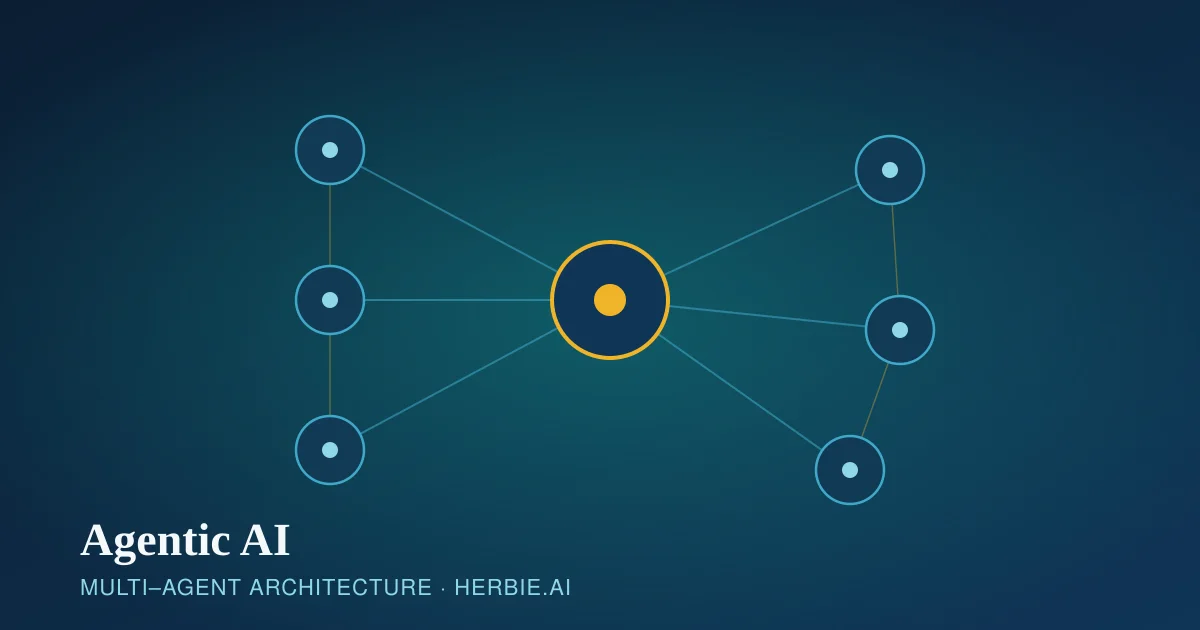
Large business processes rarely fit inside a single agent. Herbie.AI’s multi-agent orchestration uses a Supervisor Agent that delegates tasks, monitors progress, resolves conflicts, handles failures and produces one consolidated response, while specialist agents handle their own domain:
- Customer Support Agent — answers questions, tracks orders, processes returns, creates tickets
- HR Agent — leave management, attendance, benefits, onboarding, policy questions
- IT Support Agent — password resets, software requests, incidents, asset management
- Finance Agent — expense claims, invoice status, budget approvals, payment tracking
- Sales Agent — lead qualification, quotations, opportunity updates, CRM sync
- Procurement Agent — vendor lookup, purchase requests, approvals, order tracking
An employee onboarding workflow, for example, can involve the HR, IT, Security, Payroll and Facilities agents in sequence, with the Supervisor Agent making sure every step happens in the right order — the kind of next-level automation that would be brittle to hand-code as a single monolithic bot.

Human-in-the-Loop: Automation With Guardrails
Not every decision should be automated. Herbie.AI supports configurable Human-in-the-Loop (HITL) approvals for sensitive operations such as loan approvals, high-value purchases, employee termination, salary revisions, financial transactions and legal approvals. The AI makes a recommendation, a human reviews it, and only then does the agent execute the decision — balancing automation with governance.
Every agent also operates inside strict security boundaries: role-based access control, API authentication, audit logging, encryption, policy validation and tool access restrictions. Agents never get unrestricted access to enterprise systems.
Agent Memory: How Agents Keep Track of Context
Agents draw on several distinct kinds of memory to stay useful without overstepping. Working memory holds information relevant to the task at hand — the current customer, the active workflow, any pending approvals. Organizational memory gives the agent access to enterprise knowledge such as policies, contracts, SOPs and product manuals. Session memory maintains context across a single conversation, so a user doesn’t have to repeat themselves. An optional persistent memory can store user preferences where permitted — preferred language, frequently used reports, notification settings — with retention always aligned to organizational privacy policy.
What Happens When Something Goes Wrong
Enterprise systems fail in ordinary ways — an API is unavailable, data is invalid, authentication fails, a permission is denied, a network call times out, or a request runs into a business rule violation. Herbie.AI’s agents are built to handle these gracefully rather than simply erroring out: retrying execution, selecting an alternate service, asking the user for clarification, escalating to a human agent, or rolling back partial changes so a failed workflow never leaves data half-updated.
End to End: An Employee Onboarding Workflow
A single onboarding request shows how the pieces fit together in practice. An HR manager submits a request, and the Supervisor Agent coordinates a sequence across five specialist agents: the HR Agent creates the employee record, the Payroll Agent sets up compensation, the IT Agent provisions accounts and hardware, an Identity Management step grants system access, and the Facilities Agent arranges a desk and access badge — with manager approval built into the sequence before the employee is marked ready. The person submitting the request experiences one simple interaction; the coordination across five departments happens behind it.
Business Benefits of Agentic AI
| Benefit | Impact |
|---|---|
| Faster process execution | Reduced turnaround time |
| Lower operational costs | Automation of repetitive tasks |
| Improved accuracy | Standardized execution |
| Higher employee productivity | Less manual work |
| Better customer experience | Faster issue resolution |
| Enhanced compliance | Policy-driven automation |
| Scalable operations | Consistent execution across departments |
Getting Started With Agentic AI at Your Organization
Organizations getting the most out of agentic AI tend to do a few things consistently: define business objectives clearly, apply least-privilege permissions to every agent, keep knowledge sources accurate and current, require human approval for high-risk operations, and monitor agent performance and audit trails on an ongoing basis. See how these agents save time and money in practice, or talk to the team about what agentic AI could automate in your organization.