
Introduction
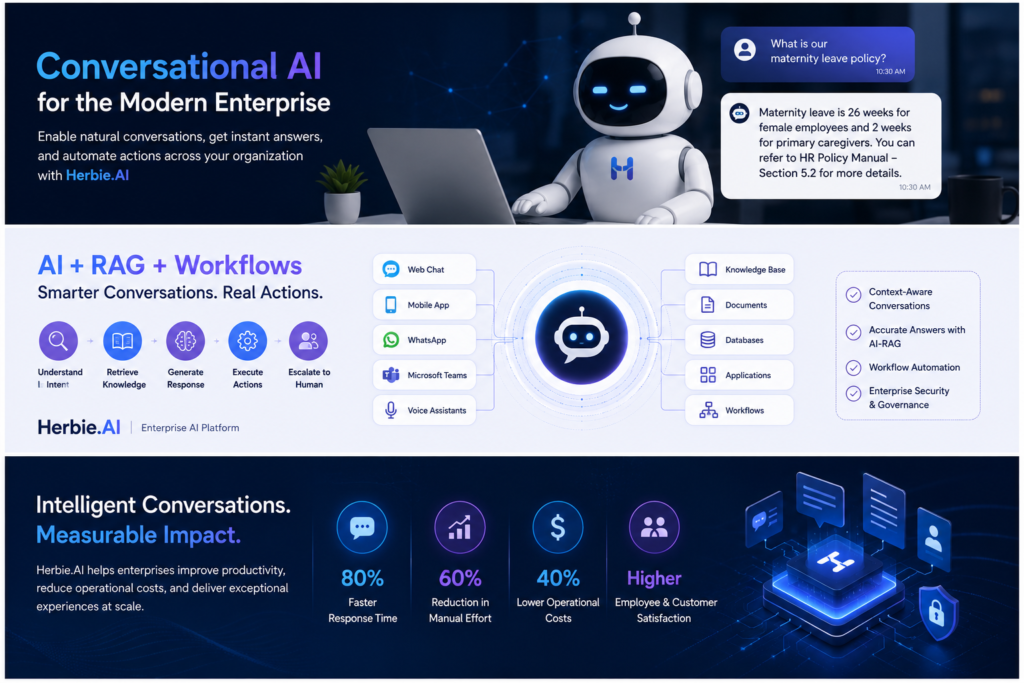
Most chatbots still feel scripted. You ask a question, and if it doesn’t match a predefined rule, the conversation stalls. Herbie.AI takes a fundamentally different approach with its Conversational AI Engine — the core layer that powers how people talk to the platform, whether by text or voice.
Instead of relying on rigid decision trees, this engine combines Natural Language Processing (NLP), Large Language Models (LLMs), AI-RAG (Retrieval-Augmented Generation), enterprise memory, and workflow automation. Together, these technologies let Herbie.AI grasp not just what someone is asking, but why they’re asking it — then either answer accurately or complete the task itself.
[Suggested image: A clean infographic showing the flow “User → NLP → LLM → Enterprise Knowledge → Action,” filename: conversational-ai-engine-flow.webp, alt text: “Herbie.AI conversational AI engine architecture diagram”]

What the Conversational AI Engine Is Built to Do
The engine is designed around a few clear goals. It needs to understand natural language, hold context across multiple messages, pull accurate information from enterprise sources, trigger workflows when necessary, and hand off to a human agent when a conversation calls for one. It also has to work consistently across every channel a business uses and support multiple languages without losing accuracy.
These aren’t separate features bolted together — they work as one continuous pipeline every time a user sends a message.
Inside the Conversation Lifecycle
Every message a user sends moves through a structured pipeline. The channel adapter receives it, the system verifies the user’s identity and session, and it detects the language being used. From there, the engine identifies intent, analyzes context, retrieves relevant knowledge through AI-RAG, and builds a prompt for the language model. Once the model generates a response, the system validates it, executes any required business action, and finally delivers the answer.
Each of these stages is monitored independently, which keeps performance, security, and response quality consistent even as usage scales.
Understanding Intent and Extracting Entities
Intent detection identifies what someone actually wants. A message like “reset my password” maps to a password-reset intent, while “apply for leave” maps to a leave-request intent. Conversations often carry more than one intent at once — for example, “reset my password and unlock my account” contains two separate requests, and the engine identifies both.
Entities add the specific details needed to act on that intent. If someone says, “Book a meeting with Raj tomorrow at 2 PM,” the system pulls out the person, date, time, and activity as distinct data points, then validates them before using them in a workflow
Why Context Matters in Real Conversations
People rarely ask complete, standalone questions. If someone asks about “Policy 102” and then follows up with “Who approved it?”, a rules-based chatbot would likely get lost. Herbie.AI’s engine keeps track of previous questions, prior answers, the active workflow, and even department-level context, so it correctly understands that “it” still refers to Policy 102.
This contextual memory is what makes conversations feel natural rather than transactional.
Grounding Answers with AI-RAG
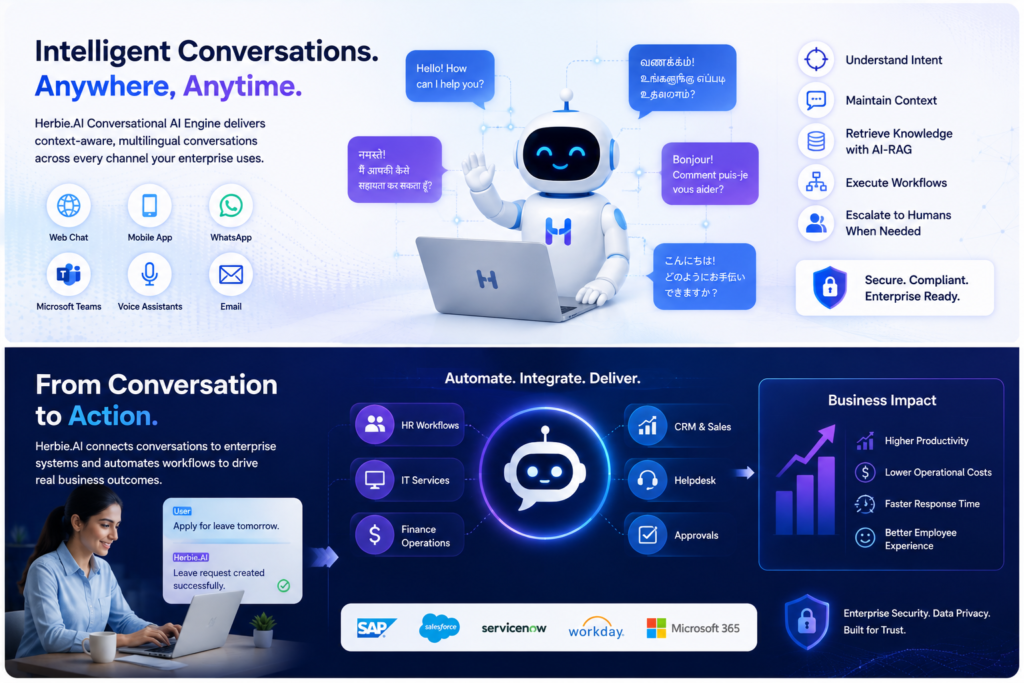
When a query needs enterprise knowledge, the engine invokes its AI-RAG pipeline. It converts the question into embeddings, searches a vector database, retrieves the most relevant document chunks, ranks them, and builds a final prompt before sending it to the LLM.
Take the question, “What is our maternity leave policy?” Rather than guessing from general training data, Herbie.AI retrieves details from the HR policy manual, the employee handbook, and the latest HR circular — then generates a response grounded in those actual documents. This matters because it reduces hallucinated or inaccurate answers, which is a common concern with generative AI in regulated industries. (For more on how retrieval-augmented generation reduces AI inaccuracy, see Google Cloud’s overview of RAG and IBM’s explainer on RAG.)
From Answers to Action
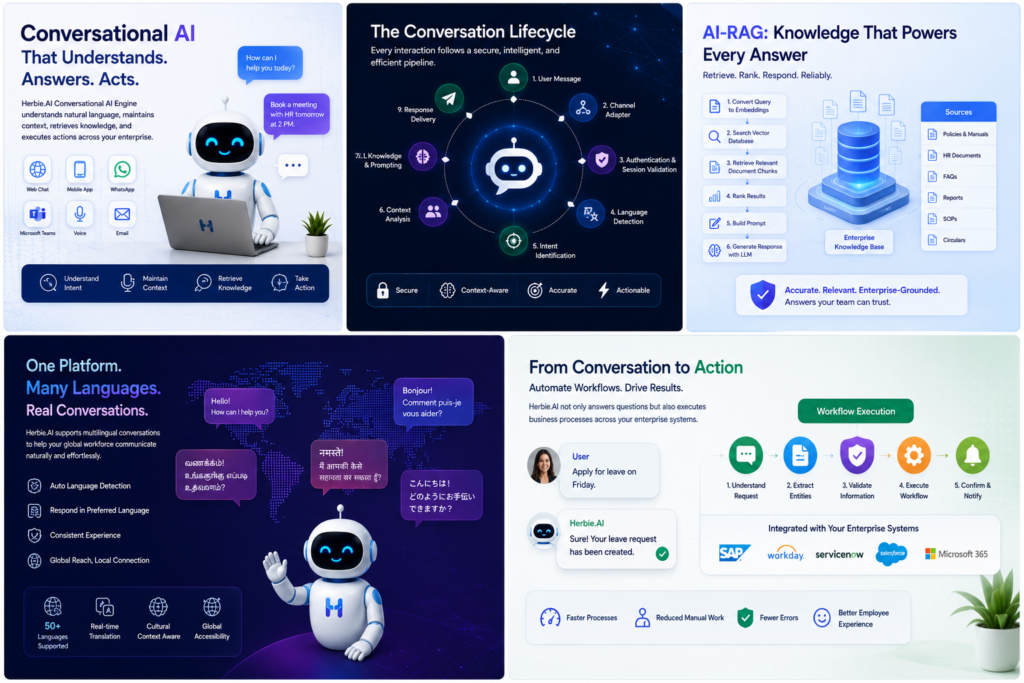
A lot of enterprise chatbots stop at giving information. Herbie.AI’s engine goes further by executing business actions directly when authorized — creating IT tickets, approving leave requests, scheduling meetings, updating CRM records, generating invoices, and more. Every action respects the organization’s permissions and policies, so automation never bypasses proper controls.
Knowing When to Bring in a Human
Not every conversation should end with AI. The engine escalates to a human agent when a user requests it, when the AI’s confidence score is low, when the topic is sensitive, or when a workflow fails. Before handing off, Herbie.AI shares the full conversation history, retrieved knowledge, and any completed or pending actions with the human agent — so the customer never has to explain themselves twice.
Personalization and Multilingual Support
Responses adapt based on who’s asking. An HR employee and a finance employee asking about “travel policy” may get different answers relevant to their own department. The engine also detects language automatically — recognizing English, Tamil, Hindi, French, Japanese, and more — and can respond in a user’s preferred language even when the source knowledge is stored in a different one.
Built-In Quality Controls
Before any response reaches a user, it passes through validation checks covering knowledge grounding, completeness, safety, sensitive-data masking, and compliance with organizational rules. Responses that don’t clear these thresholds trigger a clarification request or get escalated to a human — protecting both accuracy and trust.
Measuring What Matters
Every conversation generates operational data: total conversations, average response time, resolution rate, escalation rate, user satisfaction, and workflow completion rate. These metrics give organizations a clear, ongoing view of how well the engine is performing, so it can be continuously refined.
Final Thoughts
Herbie.AI’s Conversational AI Engine brings together language understanding, contextual memory, AI-RAG, and workflow automation into a single system that doesn’t just talk — it resolves. By grounding every response in real enterprise knowledge and knowing exactly when to loop in a human, it delivers conversations that feel accurate, personal, and genuinely useful across every channel a business supports.