
Introduction
AI is reshaping how businesses talk to customers, support employees, manage information, and run day-to-day operations. Yet most companies are still juggling a patchwork of separate tools — one for chatbots, another for document search, another for automation, another for voice, another for analytics. Keeping all of that running smoothly gets expensive fast, both in licensing fees and in the sheer effort of integrating and maintaining it all.
Herbie.AI exists to fix that fragmentation. It’s a single Enterprise AI Platform that brings Conversational AI, Generative AI, enterprise knowledge, AI-RAG, autonomous agents, workflow automation, Voice AI, analytics, and secure integrations together under one roof.
Rather than being “just another chatbot,” Herbie.AI works as an intelligent layer that sits across the whole enterprise — connecting people, knowledge, systems, and processes through AI.
The Vision
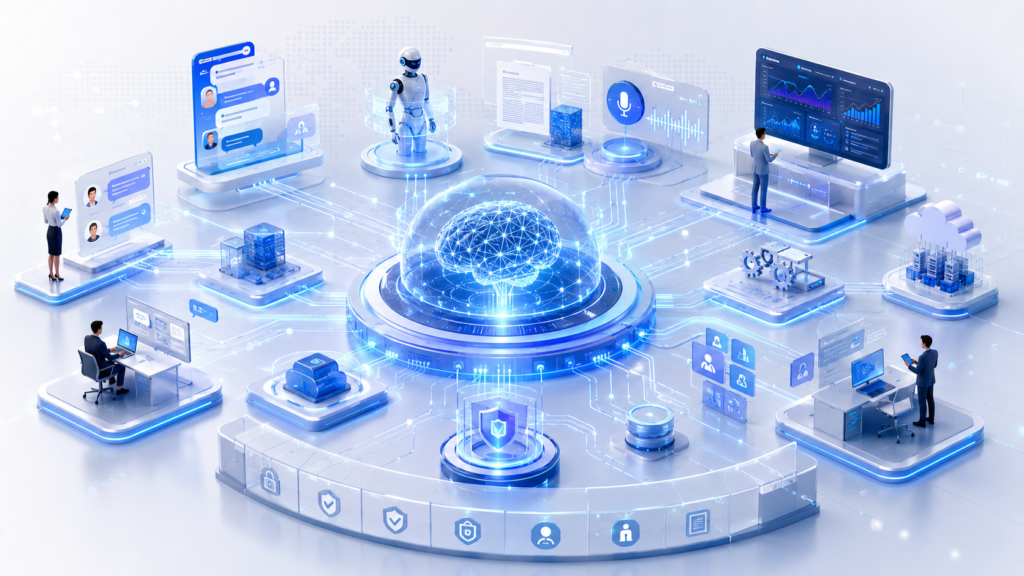
Herbie.AI aims to be the platform organizations trust to run intelligent, secure, multilingual, and increasingly autonomous digital workforces.
In practice, that means helping companies deliver better customer experiences, giving employees faster access to the knowledge they need, automating the repetitive work that eats up everyone’s day, and using AI to drive real business growth.
That vision shapes everything from the platform’s architecture and security model to how it scales, how usable it is, and how well it plays with other systems. As AI keeps evolving, Herbie.AI is built to let businesses keep pace with new capabilities — without losing the governance and control an enterprise actually needs.
Mission and Strategic Priorities
At its core, Herbie.AI is about practical outcomes: better customer service, more empowered employees, less repetitive manual work, lower operating costs, and a smoother path through digital transformation. That mission plays out through a few key priorities.
Intelligent Engagement — Natural, contextual conversations across every channel a customer or employee might use, whether that’s text or voice.
Enterprise Knowledge — AI-RAG and enterprise search mean people can just ask a question instead of digging through folders and systems for an answer.
Autonomous Operations — AI agents that plan tasks, use connected tools, call APIs, and carry workflows through to completion — moving from “AI that answers” to “AI that acts.”
Unified Integration — Native connections into the systems businesses already run: CRM, ERP, HRMS, ITSM, databases, email, and more.
Secure AI Adoption — Real enterprise AI adoption needs real governance. Herbie.AI is built with the controls, privacy safeguards, and oversight that let businesses roll AI out responsibly.
Continuous Innovation — AI moves fast. Herbie.AI is designed to evolve alongside new models, tools, and integrations so organizations aren’t stuck with what they started with.
How Organizations Grow Into AI
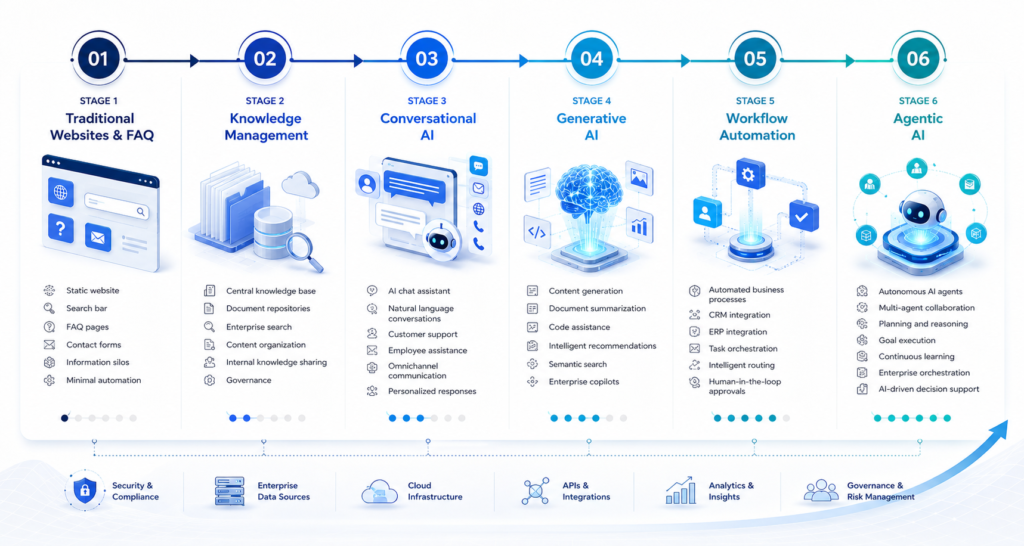
Most companies don’t jump straight to advanced AI — they get there in stages. It usually starts with a static website and an FAQ page, then moves toward knowledge management, workflow automation, conversational AI, generative AI, and eventually agentic AI.
Herbie.AI is built to support that whole journey. A business can start simple — just basic knowledge access — and layer in automation, LLM-powered conversation, AI agents, and multi-agent collaboration as they’re ready, without ripping out what already works.
What Guides the Design
- User-Centric AI — Natural language beats complicated menus. People should be able to just ask for what they need.
- Knowledge-First — AI answers are only as good as what they’re grounded in. Tying responses to real enterprise knowledge cuts down on made-up answers.
- Action-Oriented AI — Answering questions is table stakes. The real value is AI that can actually get things done through secure integrations and workflows.
- Open Integration — AI should plug into what a business already has, not force a rip-and-replace.
- Enterprise Readiness — Scalability, reliability, security, and governance aren’t nice-to-haves at this level — they’re the baseline.
- Responsible AI — Transparency, explainability, privacy, and human oversight matter, especially when AI touches real business decisions.
The Core Capability Model
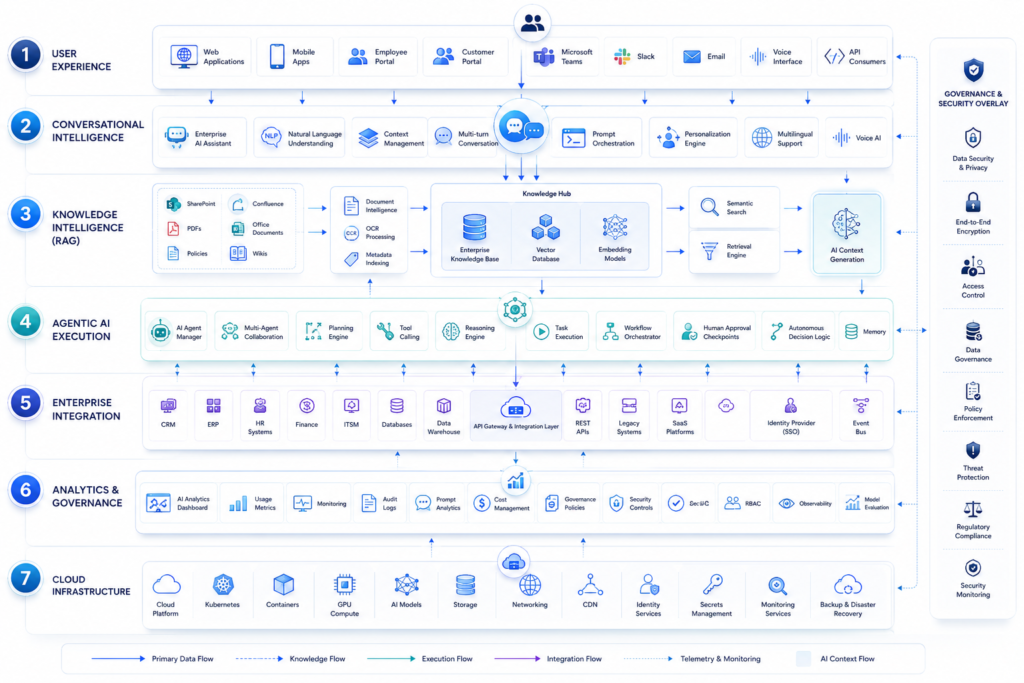
Herbie.AI is built in layers that work together as one platform:
- User Experience Layer — websites, mobile apps, voice, messaging platforms, APIs
- Conversational Intelligence Layer — natural language understanding, context handling, translation, response generation
- Knowledge Intelligence Layer — AI-RAG, enterprise search, and knowledge source connections
- Agentic AI Execution Layer — agents, planning, tool use, multi-step automation
- Enterprise Integration Layer — CRM, ERP, HRMS, ITSM, email, databases, APIs
- Analytics and Governance Layer — dashboards, auditing, security, operational visibility
- Infrastructure and Deployment Layer — cloud, hybrid, and on-premises support
Core Capabilities in Practice
Conversational AI — Multi-turn conversations that hold context, recognize intent, personalize responses, and translate across languages — over both text and voice.
AI-RAG — Pairs enterprise knowledge with large language models so answers stay grounded in real, retrievable documents rather than guesswork.
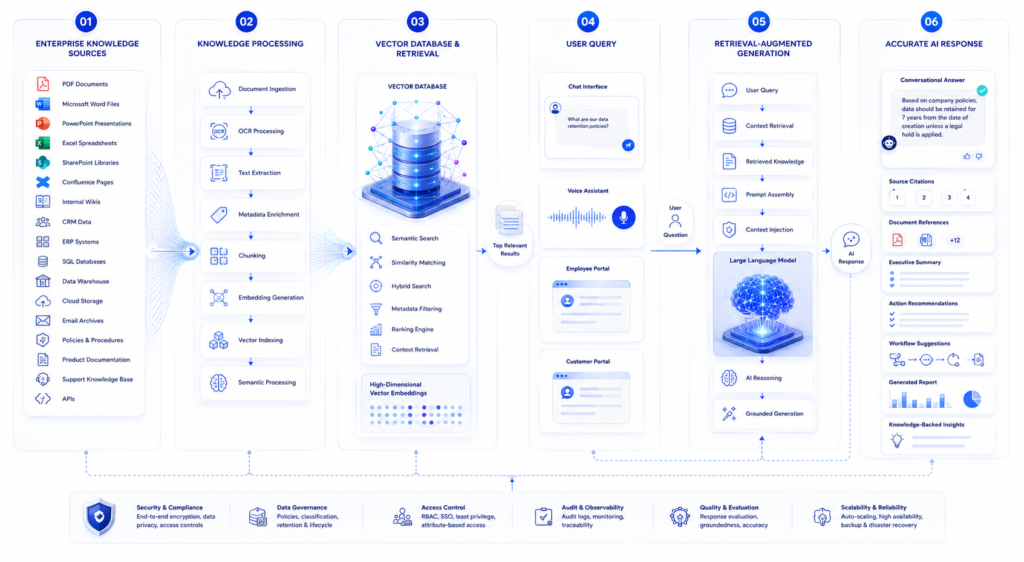
Agentic AI — Agents that plan, reason, and take action: opening support tickets, checking order status, approving leave requests, updating CRM records — the kind of multi-step work that used to require a human in the loop.
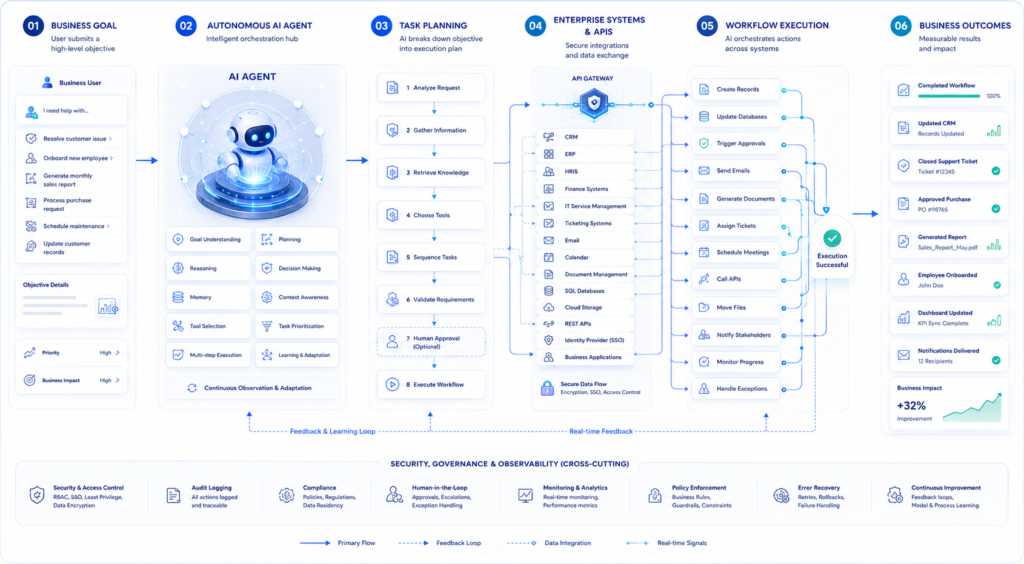
Workflow Automation — Powers processes like HR onboarding, IT service requests, customer onboarding, procurement approvals, insurance workflows, banking services, and appointment scheduling.
Voice AI — Speech recognition and synthesis for voice assistants, multilingual conversations, and contact center use cases.
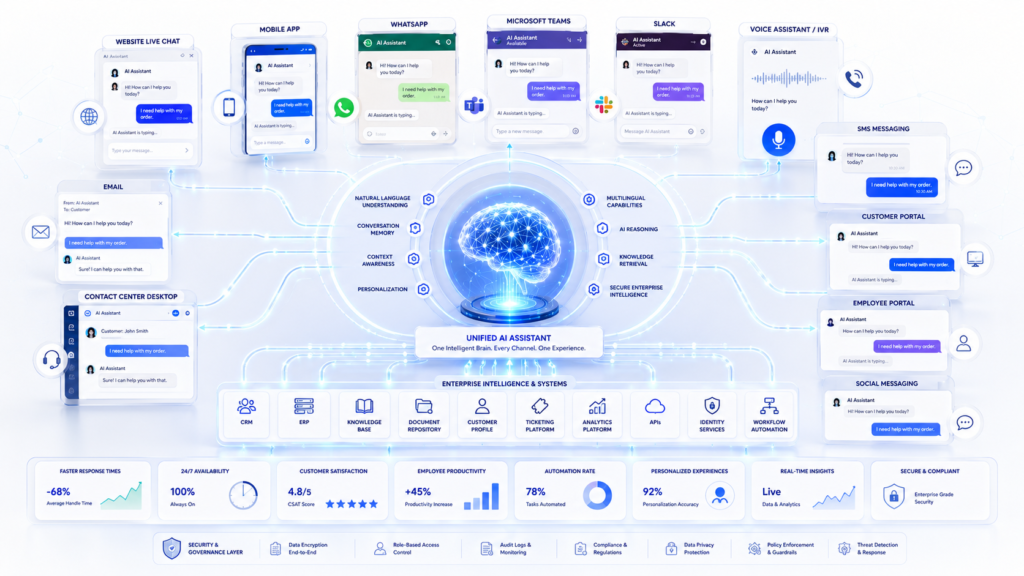
Omnichannel Engagement — One consistent AI experience across websites, mobile apps, WhatsApp, Microsoft Teams, Slack, Telegram, social platforms, contact centers, and email.
Who Benefits, and How
- Customers get faster, more personalized support.
- Employees get quicker access to the knowledge they need to do their jobs.
- Managers get better visibility into operations and KPIs.
- IT teams get centralized management and secure integrations instead of a pile of point solutions.
- Executives get a clearer strategic picture of digital transformation and business performance.
Success gets measured in things that actually matter: higher customer satisfaction, faster response times, better first-contact resolution, more productive employees, easier access to knowledge, tighter operational efficiency, and broader automation coverage.
How Implementation Typically Works
A Herbie.AI rollout usually starts with business discovery and requirements gathering, then moves through knowledge preparation, platform configuration, integration development, AI training and validation, user acceptance testing, production deployment, and a hypercare period right after launch.
The work doesn’t stop at go-live. Knowledge sources need regular updates, AI performance needs ongoing monitoring, and user feedback should keep shaping how the platform improves.
In Short
Herbie.AI brings Conversational AI, Generative AI, AI-RAG, enterprise knowledge, autonomous agents, workflow automation, Voice AI, analytics, and secure integrations into one platform — so businesses can move past disconnected AI tools and toward something more connected and genuinely intelligent.
By letting organizations adopt AI at their own pace, on top of the systems they already use, Herbie.AI helps drive better customer experiences, more productive teams, and less manual busywork — with security, integration, and responsible AI baked in from the start.
Frequently Asked Questions
What is Herbie.AI? Herbie.AI is an Enterprise AI Platform that combines Conversational AI, Generative AI, AI-RAG, autonomous AI agents, workflow automation, Voice AI, and analytics into a single system for businesses.
How is Herbie.AI different from a regular chatbot? Unlike a standalone chatbot, Herbie.AI acts as an intelligent layer across the whole enterprise, connecting people, knowledge, and systems, and going beyond answering questions to actually completing tasks through AI agents.
What is AI-RAG and why does it matter? AI-RAG (Retrieval-Augmented Generation) grounds AI responses in an organization’s own documents and knowledge sources, which helps reduce inaccurate or made-up answers.
Can Herbie.AI integrate with existing business systems? Yes. Herbie.AI is designed to connect with CRM, ERP, HRMS, ITSM, databases, email platforms, and other enterprise applications through APIs and connectors.
What can AI agents in Herbie.AI actually do? They can plan tasks, call APIs, and complete multi-step workflows such as creating support tickets, checking order status, approving leave requests, and updating CRM records.
Which channels does Herbie.AI support? Websites, mobile apps, WhatsApp, Microsoft Teams, Slack, Telegram, social platforms, contact centers, and email, all with consistent AI experiences.
Is Herbie.AI secure enough for enterprise use? It’s built with enterprise-grade security, governance, privacy controls, and human oversight in mind, which are treated as core requirements rather than add-ons.
Do organizations need to adopt every capability at once? No. Herbie.AI supports a gradual AI maturity path, letting businesses start with basic knowledge access and add automation, generative AI, and agentic capabilities over time.